
What Would You Say... You Do Here?
The question AI is forcing us all to answer.
I just watched an AI-era parody of Office Space, and I haven't stopped laughing. Or thinking. Which is mildly inconvenient, because I have things to do.
Remember that scene where the Bobs interview Tom Smykowski?
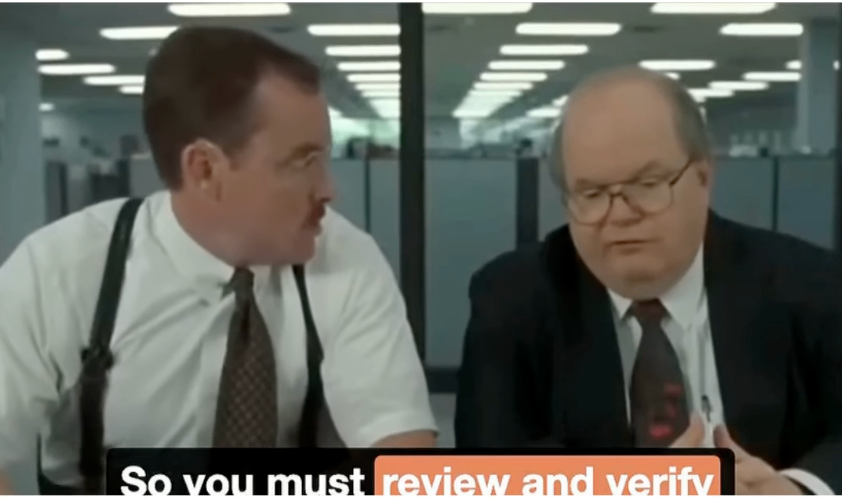
The one where Tom tries to explain that he takes specifications from customers and delivers them to the software engineers?
The Bobs, in their spectacularly deadpan corporate wisdom, ask why the customers can't just give the specifications directly to the engineers.
Tom becomes increasingly agitated. And eventually delivers one of the greatest lines in corporate cinema:
"I HAVE PEOPLE SKILLS!"
It's magnificent.
Twenty-seven years later, someone has resurrected that scene for the AI era. Except now, Tom explains that he works with AI.
The Bobs ask:
"You take the specifications from the stakeholders and put them into Claude?"
"Yes, yes. That's right."
"Why can't the stakeholders just put them directly into Claude?"
And Tom fires back: "Because stakeholders are not good at dealing with AI!"
I nearly lost it. Because, holy shit.
In 1999, Tom had people skills. In 2026, Tom has AI skills.
Different technology. Same corporate existential crisis. And suddenly, a scene that was hilarious in 1999 feels like a documentary from 2026.
The brilliance of the parody isn't merely that AI has replaced the engineer. It's that the human intermediary has found a new reason to justify his existence. And the Bobs are still asking exactly the same question:
"What would you say… you do here?"
Only now, that question might apply to just about everyone.
The Bobs Were Ahead of Their Time
The original joke wasn't really about Tom being incompetent.
It was about the absurdity of corporate structures that had become so layered, so specialized, and so disconnected from actual value creation that people struggled to articulate why their jobs existed.
Sound familiar?
I've spent more than two decades in product management. I've sat in those meetings. I've written those specifications. I've translated customer needs into product requirements, negotiated with engineering, aligned stakeholders, facilitated decisions, and produced enough documentation to deforest a small country.
And yes, occasionally, I've wondered whether the meeting about the meeting could have been replaced by a fucking email.
But here's what makes the modern parody so delicious. The Bobs are no longer asking why one group of humans can't communicate directly with another. They're asking why a human is needed to communicate with AI.
And Tom's answer? Because the stakeholders aren't good at it. Which, frankly, might be true.
Anyone who's worked with stakeholders knows that clearly articulating what you want isn't always as straightforward as it sounds. Sometimes what people ask for isn't what they actually need. Sometimes the requirements contradict each other. Sometimes everyone agrees on a solution before anyone has established what problem they're trying to solve.
And sometimes the stakeholder just wants a dashboard.
Why? Because the other department has a dashboard. Naturally.
So yes, there can be tremendous value in having someone who understands the problem, challenges assumptions, translates ambiguity into clarity, and knows how to work effectively with AI. But there's an uncomfortable distinction hiding inside Tom's defense.
Knowing how to use AI isn't necessarily the same as knowing how to create value with AI.
And that's where the satire lands. Because some people are genuinely exercising judgment, imagination, and expertise. Others are simply moving information from one interface to another. And increasingly, both can describe their jobs as "working with AI."
We've invented a new technological vocabulary for a very old organizational ambiguity.
And the Bobs are still unimpressed.
We Used to Be the Ones Frustrated With the Machines
There's another iconic scene in Office Space. Three disgruntled employees take a perpetually malfunctioning printer into a field and beat the living shit out of it. A glorious moment of human triumph over technological incompetence.
In 1999, the machines couldn't do what we needed them to do.
In 2026, the machines are increasingly doing things we thought only we could do.
The irony is exquisite.
We spent decades complaining that technology wasn't smart enough. Now we're increasingly worried it's becoming too smart. We wanted machines to make our jobs easier. We just weren't entirely prepared for the possibility that they might make parts of our jobs unnecessary.
Be careful what you wish for, I suppose. But there's an even more fascinating reversal underway. For decades, humans served as the connective tissue between complex systems.
We translated.
Coordinated.
Interpreted.
Communicated.
Managed handoffs.
Now AI can increasingly perform those functions itself. Not just between humans and machines. Between machines and other machines. And here's where Tom's defense becomes especially precarious.
What happens when AI becomes better at dealing with stakeholders than Tom is?
Not just better at receiving instructions. Better at asking clarifying questions. Better at identifying contradictory requirements. Better at probing for the underlying business problem. Better at helping stakeholders articulate what they actually want.
Suddenly, even the ability to bridge the gap between people and AI becomes something AI might perform.
And our poor friend Tom is back in the conference room. With the Bobs. Again.
Everyone's a Creator Now. So What?
Here's where this gets particularly interesting for me.
I'm currently building two businesses, and AI has become an integral part of how I think, strategize, write, challenge assumptions, and bring ideas into existence.
Things that once required substantial resources, specialized expertise, and weeks of coordination can now happen in hours. Sometimes minutes. It's extraordinary. And I love it.
I'm not mourning the disappearance of tedious work. Good riddance. But I've also noticed something fascinating.
The distance between having an idea and producing something that looks like a finished creation is collapsing.
Someone who has never written code can build an application. Someone who has never studied design can generate a brand identity. Someone who has never written an essay can publish something polished, persuasive, and remarkably articulate.
That is genuinely democratizing. And it raises some fascinating questions.
When almost anyone can produce something impressive, what makes the work meaningful?
Is it the quality of the output?
The originality of the idea?
The intention behind it?
The judgment exercised along the way?
Or something else entirely?
And before we rush to proclaim that human creativity, critical thinking, and discernment are what will save us, let's acknowledge something.
AI is getting increasingly capable of doing those things, too. Perhaps not identically to humans. Perhaps not consistently. But the trajectory is difficult to ignore.
Which makes me wonder whether we're asking the wrong question when we obsess over what humans will always do better than machines.
What if the point isn't to find the one thing AI can never replace?
And here's where I have to laugh at myself. Because I've spent over twenty years developing skills that are now being fundamentally reshaped by the technology I'm enthusiastically using.
I'm a product leader.
I'm a founder.
I'm a stakeholder.
I'm the person translating ideas into specifications.
I'm the person asking AI to help turn those specifications into something tangible.
And occasionally, I'm the person interrogating whether any of those steps were necessary in the first place.
I'm Tom. I'm the stakeholder. And apparently, I'm also one of the Bobs.
Well, fuck.
The Difference Between Producing and Creating
There's a distinction I've been thinking about. Producing something and experiencing the act of creation aren't necessarily the same thing.
An AI can generate a beautiful piece of music. But what happens to the musician while composing?
An AI can write a compelling story. But what happens to the writer while wrestling with an idea, discovering an unexpected truth, or finding language for something they didn't previously understand?
An AI can generate software. But what happens to the person who imagines a possibility, tests it against reality, encounters resistance, and discovers something entirely different along the way?
The output matters. Of course it does. But perhaps something equally valuable has always been happening within the creator. And we've largely ignored it because we live in a world obsessed with measuring what gets produced.
How much.
How fast.
How efficiently.
How profitably.
Now we've created machines that can dramatically outperform us on some of those measures. And we're surprised to discover that our definitions of productivity and value are beginning to feel inadequate.
There's a certain cosmic comedy to that. And perhaps an uncomfortable question lurking beneath it:
If AI can increasingly handle the output, will we still value the experience of creating?
Or will we gradually abandon parts of that experience because producing the result ourselves no longer makes economic sense?
I don't think the answer is obvious. And I don't think it should be. Because AI can also expand the experience of creation. It can help us explore possibilities we couldn't have imagined alone. It can challenge our assumptions, introduce unexpected connections, and invite us into unfamiliar creative territory.
Sometimes it might diminish our engagement. Sometimes it might deepen it.
The technology itself doesn't necessarily determine which. Our relationship with it does. And that distinction feels increasingly important.
The Joke Might Actually Be on the Bobs
Here's my favorite part of this thought experiment.
In the original Office Space, the Bobs were the arbiters of organizational value. They got to decide which jobs were necessary and which employees were redundant.
But imagine the 2026 version. After interrogating Tom about his AI skills, the Bobs return to their office. They open an AI application. They upload the organizational chart, payroll data, performance metrics, and business objectives. And they ask:
"Identify opportunities to improve organizational efficiency."
The AI analyzes the company. Then recommends eliminating the external management consultants.
The Bobs.
Well, shit.
Turns out the people deciding who's replaceable might be replaceable, too. But let's not stop there.
What about the executives who hired them?
The department heads?
The people determining strategic priorities?
If AI can increasingly analyze markets, evaluate organizational performance, model strategic scenarios, and recommend decisions, why couldn't leadership simply consult AI directly?
And if AI agents can communicate with other AI agents, coordinate execution, and report outcomes, why do we need so many layers between an intention and its implementation?
Now, there are legitimate answers.
Authority matters.
Accountability matters.
Ownership matters.
The consequences of decisions matter.
And organizations don't operate on analysis alone.
But those distinctions become more important precisely because AI is making so many traditional activities easier to automate. Which brings us to another uncomfortable possibility.
What if the Bobs eventually have to ask the stakeholders why they're needed, too?
After all, if the stakeholders are merely passing along instructions from someone higher up, aren't they also intermediaries? And if the executives are making decisions based on analyses and recommendations generated by AI, what exactly are they contributing?
Follow that logic far enough, and eventually you reach the people who own the company.
At which point the questions change. Not simply who performs the work. But who controls the systems. Who determines the objectives. Who benefits from the productivity. And who bears the consequences.
Suddenly, we're no longer talking about a middle manager putting specifications into Claude. We're talking about the architecture of economic power. All because two fictional management consultants asked one very reasonable question.
"Why can't the stakeholders just put them directly into Claude?"
I fucking love satire.
Maybe We've Been Asking the Wrong Question All Along
There's something both liberating and deeply unsettling about this moment in history.
AI is challenging assumptions about expertise, creativity, intelligence, productivity, and professional identity.
But perhaps the most profound disruption isn't technological. Perhaps it's philosophical.
For generations, we've become accustomed to defining ourselves through what we do.
Our professions.
Our accomplishments.
Our expertise.
Our productivity.
Our usefulness.
And somewhere along the way, we started confusing our economic value with our human worth. AI didn't create that confusion. It's just making it increasingly difficult to ignore.
Because when a machine can perform tasks that once took us decades to master, we're confronted with a question that has nothing to do with technology.
If I am no longer uniquely valuable because of what I can produce… Who am I?
And what do I actually want to do with the extraordinary experience of being alive?
I don't have a tidy answer. Frankly, I'm suspicious of anyone who claims to have one. But I'm fascinated by the possibilities.
Maybe the future of human creation isn't about competing with machines for the title of Most Productive Entity. Maybe it's about reclaiming aspects of creation that we've neglected while optimizing everything for efficiency.
Curiosity.
Play.
Experimentation.
Expression.
Connection.
The pleasure of making something simply because we want to.
Not because a stakeholder requested it. Not because it advances a quarterly objective. Not because it can be monetized.
But because being human involves more than generating outputs. And perhaps that's the part worth paying attention to.
There's an important distinction here, though. Being liberated from work isn't necessarily the same thing as being liberated to live. Automation can create extraordinary possibilities. It can also concentrate power, destabilize livelihoods, and leave people wondering where they belong in an economy that no longer needs their particular skills.
Those aren't abstract philosophical concerns. They're real questions about how we organize society, distribute opportunity, and determine who gets to benefit from technological progress.
Which is why I don't think the answer is simply to celebrate AI or fear it.
It's to become much more intentional about what we're building, why we're building it, and what kind of human experience we want these technologies to make possible.
Because here's the thing. The next time someone asks: "What would you say… you do here?"
I hope we don't all scramble to produce a list of tasks a machine hasn't learned to perform yet. I hope we have the audacity to question the premise. After all, we're not merely here to be useful.
We're here to live.
And if we can figure out how to let machines do more of the work without surrendering the experiences that make our lives meaningful… Well. That might actually be worth creating. :)
Written by a product leader who's spent more than two decades building technology, is now building businesses with AI, and finds herself increasingly entertained by the possibility that the biggest disruption may be to our own assumptions about what makes us valuable.
And yes, I used AI to help write this.
The Bobs would like a word.