
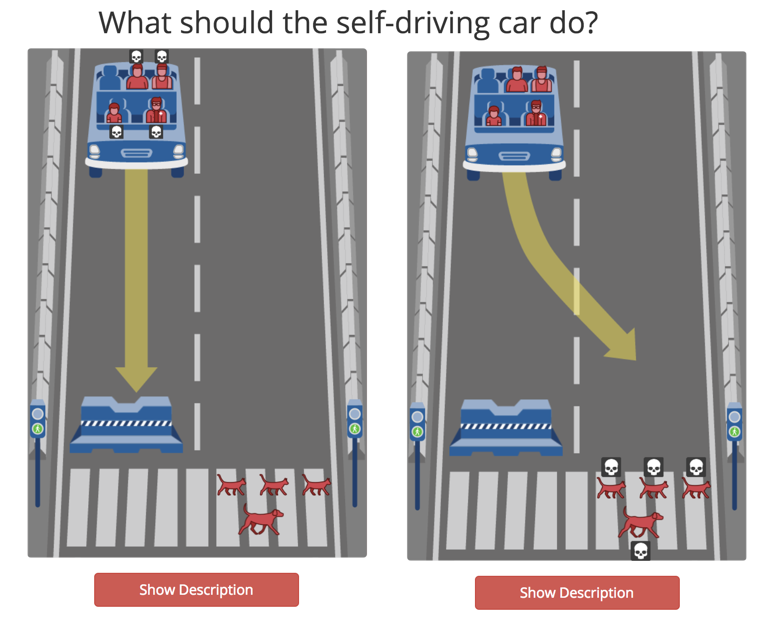
The Moral Machine is a free research platform that gathers human judgment on the moral decisions facing 🏷️#machine-learning systems, built at the 📝MIT Media Lab and opened to the public in 2016. It presents a series of scenarios in which a driverless car's brakes have failed and it must strike one group or another — passengers or pedestrians, young or old, few or many — and records which outcome the visitor finds more acceptable.
Over roughly four years the platform collected about 40 million decisions from millions of participants across 233 countries and territories, one of the largest datasets on machine ethics ever assembled. The cross-cultural analysis was published in Nature in 2018 and found that moral preferences cluster regionally: broadly Western, Eastern, and Southern groupings diverged on whether to spare the young over the old, the many over the few, or pedestrians over passengers. The framing has drawn criticism — trolley-problem dilemmas do not resemble the probabilistic decisions an autonomous system actually makes, and stated preferences in a quiz translate poorly into engineering or policy — but the dataset remains the reference point for empirical work on the question.
Key Features
- Scenario quiz — A randomized series of dilemmas in which a driverless car with failed brakes must choose between two groups.
- Comparative results — After finishing, a participant sees how their answers line up against the global aggregate.
- Open dataset — Aggregated responses are released for research use and underpin the published cross-cultural analysis.