
How Airbyte doubled 📝SDR booking rates using Octave
A big part of my job working in growth and 📝GTM engineering at startups like Hearth, Rippling, and now Netic is trying out a lot of new products and running experiments. I was an early user of many now popular GTM engineering tools like 📝Clay, 📝HeyReach, and PhantomBuster.
I’ve found that 📝GTM alpha comes primarily from ideas, software, and workflows that others haven’t found yet. So, I try new tools and ideas, often.
In a new segment on The GTM Engineer, I am going to be open-sourcing my experiments, meaning I’ll be sharing learnings as I try new tools and workflows - documenting what works, what doesn’t, and what I think is really going on. I’ll also be asking others (mostly from The GTM Engineer Lab) for their most successful experiments and sharing their learnings, some of which may really surprise you.
This is all part of my mission in running The GTM Engineer - to help the community gain insight into what’s happening on the front lines in GTM Engineering and Growth, so they can have more successful careers, products, and businesses. You should be able to take learnings from these experiments and apply them to your own work (and you’ll have to tell me what works! Just reply to this email).
Today, I’m sharing how Laura Strazdina, GTM Engineer at 📝Airbyte (an open-source data integration & ETL platform w/ ~$180M raised), used Octave to double SDR booking rates from 📝cold email (up to 4%, and ~2x what I have normally seen). After starting with automated outbound, they’ve expanded their 📝Octave use across lead qualification, account research, and content marketing as well.
In this essay, I’ll go into detail on exactly what Laura did and dig into what’s important to get right if you’re looking to build something similar.
As I learned more about Laura’s implementation of Octave, I became convinced that, when used correctly, Octave can be an absolute game-changer for storing, organizing, and actioning off of context to level up your entire GTM motion. It’s also why I was excited to write about them, and decided to partner with them to produce this post. Big thank you to Octave for supporting the GTM Engineering community!
---
So what is Octave?
As a GTM engineer, you’ve probably built workflows, Clay tables, agents and automated campaigns. Two common issues are that, although you’ve set up some pretty complicated, nuanced workflows, they don’t cascade throughout your entire GTM motion (ads, lifecycle campaigns, SDR messaging, etc), and they don’t adapt as you learn more about your users.
The reason why…I’ll save you some time…is stale, disconnected context. In other words, the data you’re piping into the system is not as relevant as it was many months ago, and that context is not making it everywhere it needs to go.
The most valuable knowledge from sales and marketing (ICPs, winning messaging, competitor positioning, specific use cases) often lives in gated docs, call transcripts, email templates, and other tools. Octave’s GTM intelligence layer solves this problem by pushing this strategic context + new dynamic context like intent signals into every system you’ve built, automatically, and it gets smarter automatically over time.
---
How 1-person GTME teams are scaling their time while nailing personalized messaging with their SDRs
Laura wanted her SDR team to personalize every touchpoint without wasting time manually writing copy everyday.
The old way of solving this was pretty slow and would usually result in suboptimal outcomes. Marketers would create copy templates across a few different buckets - a cold message to C-Suite, a warmer one to mid-level job changers, another for webinar follow up, and so on.
SDRs would also build out their own templates and have to figure out for themselves where each prospect was in the funnel to adapt the message.
In both scenarios, you’d typically end up with dozens of distinct templates across characteristics like persona, company size, industry, and signal. A few might be good, but a lot of your team would be sending copy that makes marketing cringe, and, no matter what, there would be dozens of outdated templates floating around the GTM org.
As a one-person GTME team, this wasn’t even an option for Laura. She had sophisticated systems to build!
So, she set out to create an automated outbound engine on top of the foundational business context required to write high quality, performant, copy that could adapt based on dynamic variables like signals or new internal initiatives.
She used Octave to set this all up so she barely had to think about it after the initial configuration. She invested upfront and fed all of the Airbyte context into Octave - 📝ICP, positioning, differentiated messaging, call recordings, deals, email replies, and more.
The outcome?
A highly effective, AI-enabled SDR org that drove 4% cold booking rates from email, and even stronger conversion in HeyReach.
“Octave was this game changer that unknowingly unblocked us in a lot of ways and helped make our messaging less generic and more creative.”
Exactly how Laura built this
Octave gave Laura a structured place to input all of the relevant context about Airbyte. Product offerings, value props, personas, market segments, competitors, buying triggers, and more. It also automatically researched their business to give them a working v1 within minutes.
After Laura filled this info in, Octave analyzed it, connected the dots and wired it into a custom context graph that could push through all of Airbyte’s systems. She was able to build once and push personalization into any GTM activity as an agent/API to run on-demand, instead of building more templates and brittle prompt chains that inevitably break with product or marketing shifts.
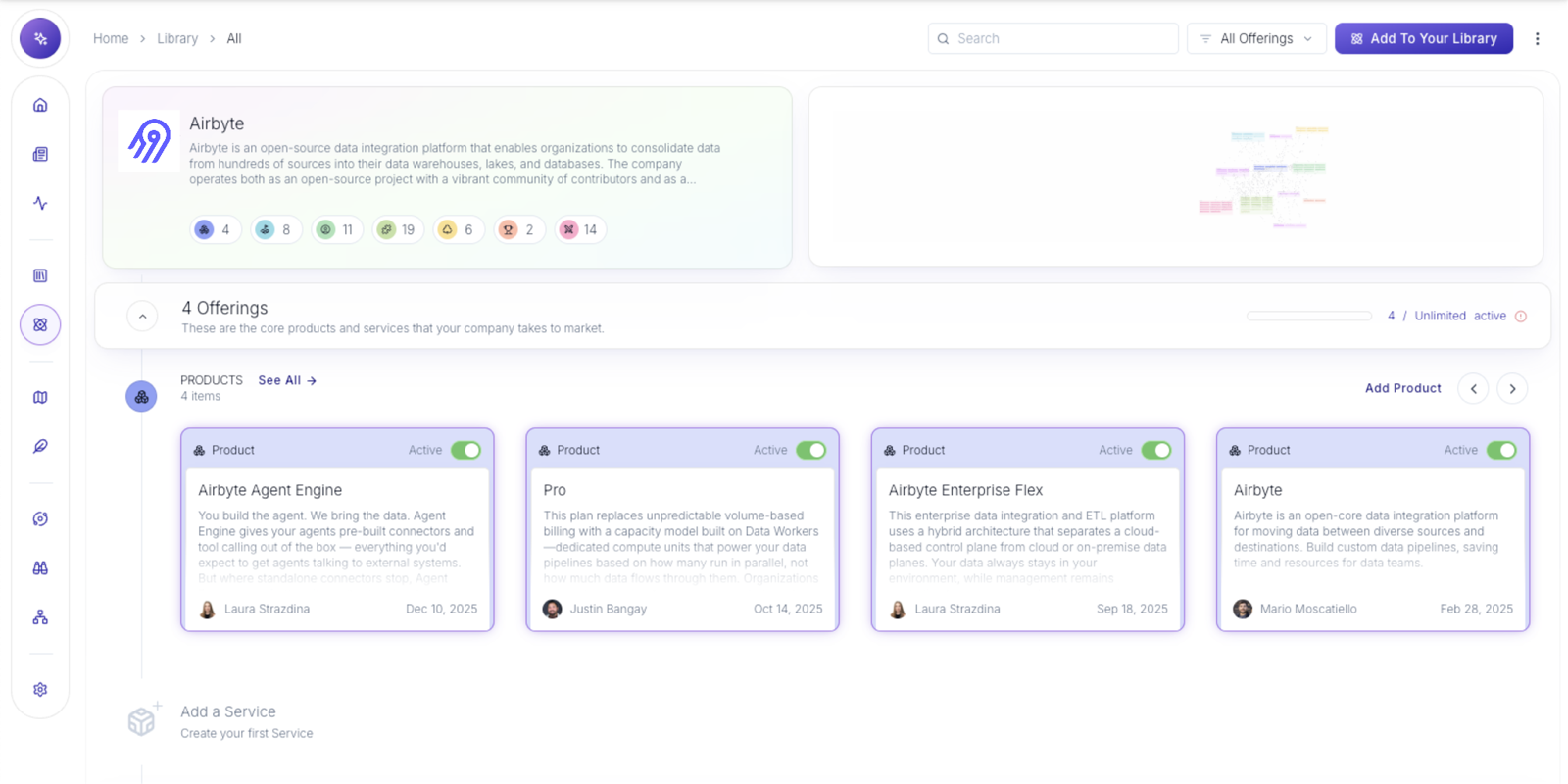
Here’s exactly what Laura did in detail:
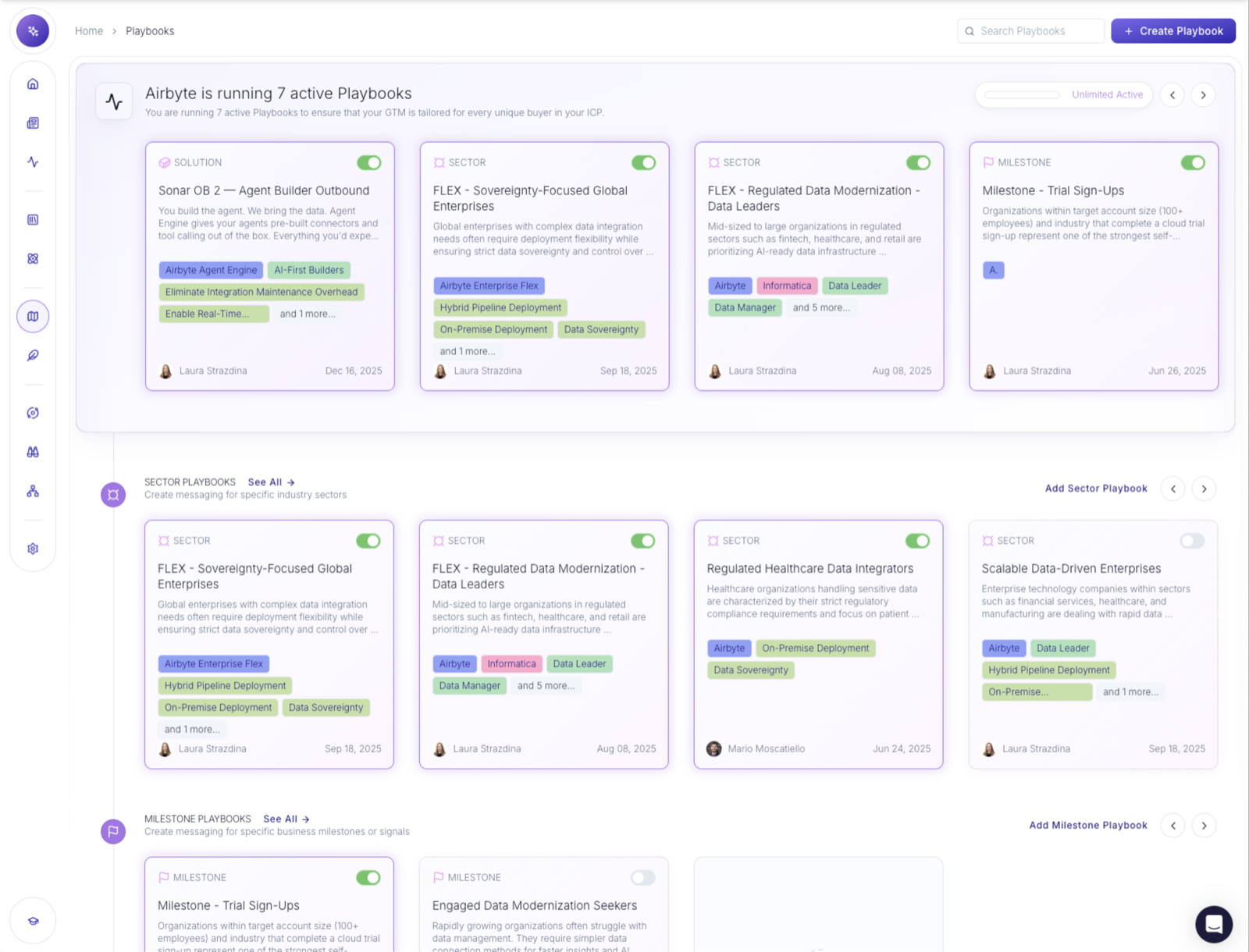
- Built the context library in Octave using Airbyte’s ICP, positioning, personas, use cases, and differentiated messaging angles for their core plays. This is the upfront investment that makes everything else work. To get this right, Laura’s team used Octave to store and structure:Products and features: For each product include things like capabilities, differentiators, challenges addressed, and qualifying questions.ICP and persona definitions: These are the foundation for the outbound campaign targeting. For each persona, include things like pain points, job functions, and buying triggers.Messaging and value props: This is what made the emails “less generic and more creative,” while speaking to real-world use cases their buyers recognize. These are the specific words and types of emails her and her team have seen work for their buyer.Competitive battle cards and case studies: This is how Airbyte explains competitors during SDR onboarding and enablement sessions.
- Configured Octave qualification and sequence agents to pull from their playbooks and library context. This is where Laura layered in dynamic context like their most relevant point-in-time signals.
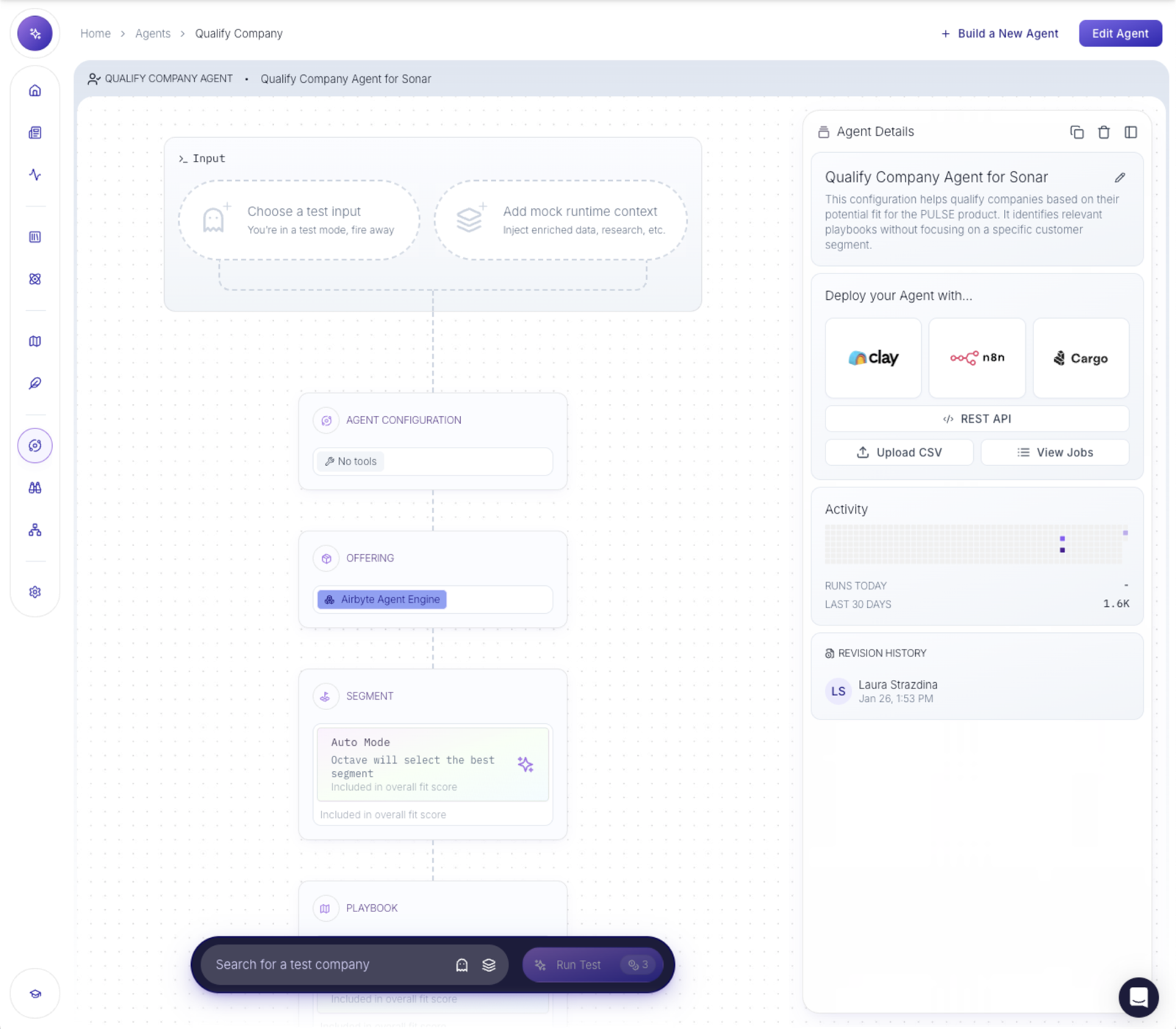
- Connected to their sending tools - Instantly for email, HeyReach for LinkedIn, and Common Room for signals. Octave is then able to feed all of the context directly into the platforms used for execution.
- Tiered SDR involvement based on account quality with automation. Laura gave SDRs an extra place to input context and personalization on their Tier 1 named accounts, while running evergreen flows and agentic air cover against the rest of the 📝TAM.
- Handed the fully baked agentic system to her SDRs, so she no longer had to be in the loop on every send.
This same pattern works beyond outbound, too. Laura ran scoring agents to process event lists, pulling Octave context into the 📝pipeline wherever personalization or judgment was needed. When Airbyte hired a new SDR, the team used Octave to generate their onboarding docs and battle cards directly from the library. They’re also now using Octave in lifecycle campaigns, content marketing workflows, and as a real-time context layer feeding into Claude and Claude Code via MCP and Octave’s plugin.
Why Octave is uniquely suited to support this experiment
“Context is something you need to think about up front. What your agent knows right now with the persistent context versus what you’re going to be giving it at the time it’s running the campaign — that’s a lot of concepts that are just new to people.”
Octave’s architecture runs on two layers: foundational context and runtime context.
Foundational context is the GTM intelligence Octave holds and evolves over time: Airbyte’s positioning, ICP signals, messaging frameworks, competitive angles, etc. Laura built this out once, and it compounded from there: every new call, CRM update, or competitor positioning shift automatically gets folded back in. It’s living knowledge that every workflow draws from, forever.
Runtime context is what flows through the agent at the time of execution: the specific contact, their company, and the signals that triggered the outreach. It knows what Airbyte cares about, who it’s talking to right now, and it can act accordingly.
Octave also structures this in a very easy-to-access way. It makes your GTM knowledge legible and actionable to you and AI agents. You don’t have to chase it down in Slack, Google Docs, or Gong calls each time, or repeat it over and over to new hires. This also works inside of Claude (and other LLMs) via MCP, plus directly inside of Octave via guided chat.
Final thoughts
Almost every growth and GTM Engineering leader I’ve talked to that is scaling their company has either recently figured out how to handle context in their GTM motion, or they are actively figuring it out now. How do you create a central place to capture and use all this critical historical information when you have so many people at the company interfacing with GTM?
Octave is a very effective way to do this. It not only offers a simple interface to intake the context, but it can handle dynamic context (like signals) and it can push that context into all of your existing workflows.
It’s natively self-learning by pulling data in from sales calls and closed won deals, and it provides an open architecture (via agents, APIs, and MCP), so that teams can focus on the outcome instead of the context infrastructure.
As you get set up building your context engine, here are a few things to remember from Laura:
Order of operations matters
Know your goal, your list, and your context before touching the agent. This will help you discern what to put into Octave and quickly iterate until your sequences read like the copy your best marketer would write. For GTM engineers: build it yourself first, then hand it off.
Invest effort up front to save time later
Building context into Octave initially takes time, but is a worthwhile one-time investment that requires smaller adjustments over time. Treat Octave as your single source of truth, your GTM brain.
Continue to update your system over time
Maintaining this infrastructure is critical. Laura suggests keeping Octave updated so that every downstream agent gets better, and she recommends using Octave in the first place to help offload the maintenance burden that often grows with the complexity of your GTM motion. Some of the updating is handled autonomously, but it’s also important to have stakeholders in the org (like PMMs) that inject their domain knowledge.
---
Thanks for reading! Let me know if you try this out and reply to this email if you have a GTM Engineering Experiment you’d like featured :)