
How Profound’s Nick Lafferty 10x-ed CTR on a 1:1 LinkedIn 📝ABM Campaign using Claude Code
Hi I’m Jay! I’ll be writing this issue of the GTM Engineer. I’m an ex-consultant turned GTME, and a friend of the pod.
Today, we’re diving deep into how Nick Lafferty used Claude Code to build 1:1 ABM ads that mentioned a competitor and drove a 10x CTR (click-through rate). Nick is the Founding Market Engineer @ Profound, and joined when the company was around 20 people. Prior to Profound, he was the Head of Growth at Loom and spent two years running a successful marketing agency.
Account-based-marketing (ABM) is the idea of running very personalized marketing to an individual account, because the value of that account is worth the effort to personalize.
You can run ABM across channels like LinkedIn, direct mail, personalized outbound, events, and so on. Anything that allows you to provide a very catered experience to the user.
Nick saw how effective LinkedIn ABM ads were during his time at Loom, and he wanted to experiment with it at Profound. He knew that ABM was worth the investment if it increased demo bookings with their key set of accounts.
LinkedIn in particular is useful for ABM since it allows for extremely granular targeting (company / title / location / etc).
In the pre-AI world, ABM ads were built one by one for each target account. Creatives had to be manually configured. Logos had to be copy pasted from Google images. Don’t even get me started on deployment.
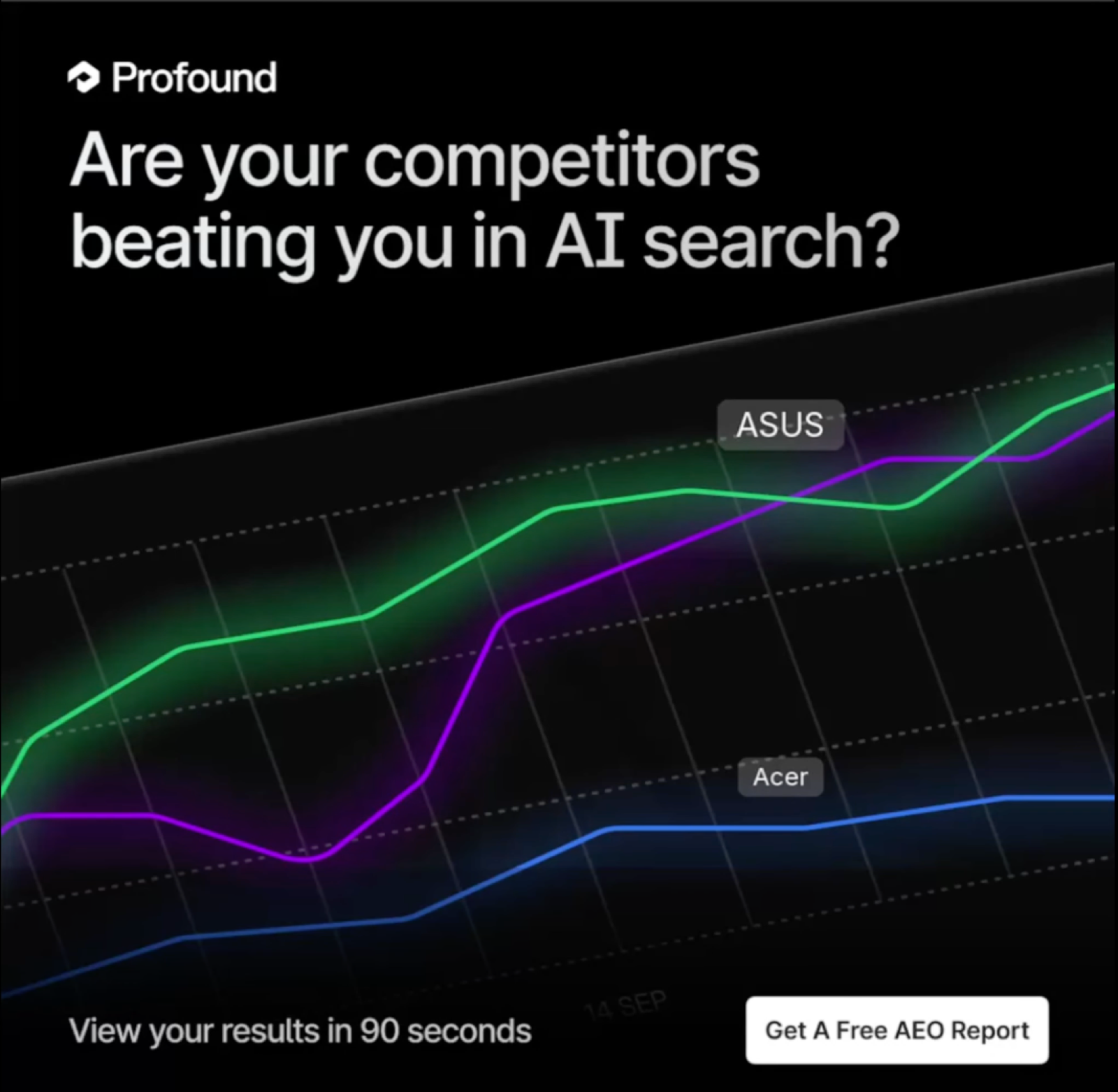
Each level of personalization of the ad was done by humans. However, with Claude Code, Nick was able to quickly build a custom ABM campaign for >100 accounts, off of a single design.
In doing so, he managed to achieve a CTR of around 5% - 6%, compared to typical LinkedIn ad CTR benchmarks of 0.4%.
In the following write-up, we’ll outline Nick’s exact workflow, how you can apply his design principles immediately, and hopefully expand your thinking on what’s possible with AI.
For me, it’s another stellar example of how AI is enabling customization across every step of the marketing funnel. I’ve still seen very few companies actually running personalized ABM ads at scale, so if you can act fast, there’s a serious arbitrage opportunity to cut through the noise.
---
“In the past I had to go google Loom logo, Profound logo... so the fact that I could just rip a bunch of these logos in a minute was the huge unlock for me.”
Nick’s step by step process, explained:
- Started with a strategic list of 100+ accounts:Nick had a strategic list of 100 mid-market / enterprise accounts.For your company, ask yourself: Do you have your “Top 100”? What criteria would you use to identify them?
- Got a base ad template from his design team:Nick then asked his design team for a basic Profound-themed template that he could use as a starting point.If your design team is backlogged and busy, can you generate it yourself? Often times, the optimal play is to build your own “good enough” creative, rather than the “beautiful” creative that takes weeks to spin up,
- Enriched the account list with competitor and firmographic information using CC (Claude Code):Next, Nick determined how much personalization was needed. Instead of displaying only the target account, he added another dynamic field to make the ad even more impactful (their top competitor). This works for Profound because AI search is a category with a lot of FOMO right now.To execute on this, Nick used CC to spawn sub-agents that ran web searches to match an account with their competitorArguably AI could’ve been used to increase personalization further, such as having custom copy for each ABM ad, too.
- Leveraged Logo.dev’s API to pull the logos automatically:Nick experimented with a couple of different logo providers. After providing CC the API through his .env file, CC was able to pull the logos for all the target accounts and their competitors.This took zerocoding skills from Nick - all he did was explain the process to CC in natural language, sign up for Logo.dev, and paste the API key into the project.Nick mentioned that it took some iteration to decide whether to use wordmarks or logos. He assessed which ones fit better with the ad template, due to factors like background color / logo margins.What’s the most tedious task in your current work? Or what would you love to do but you’re blocked by a cumbersome process? AI can now unlock all of those opportunities, either through an API or a computer-use agent.
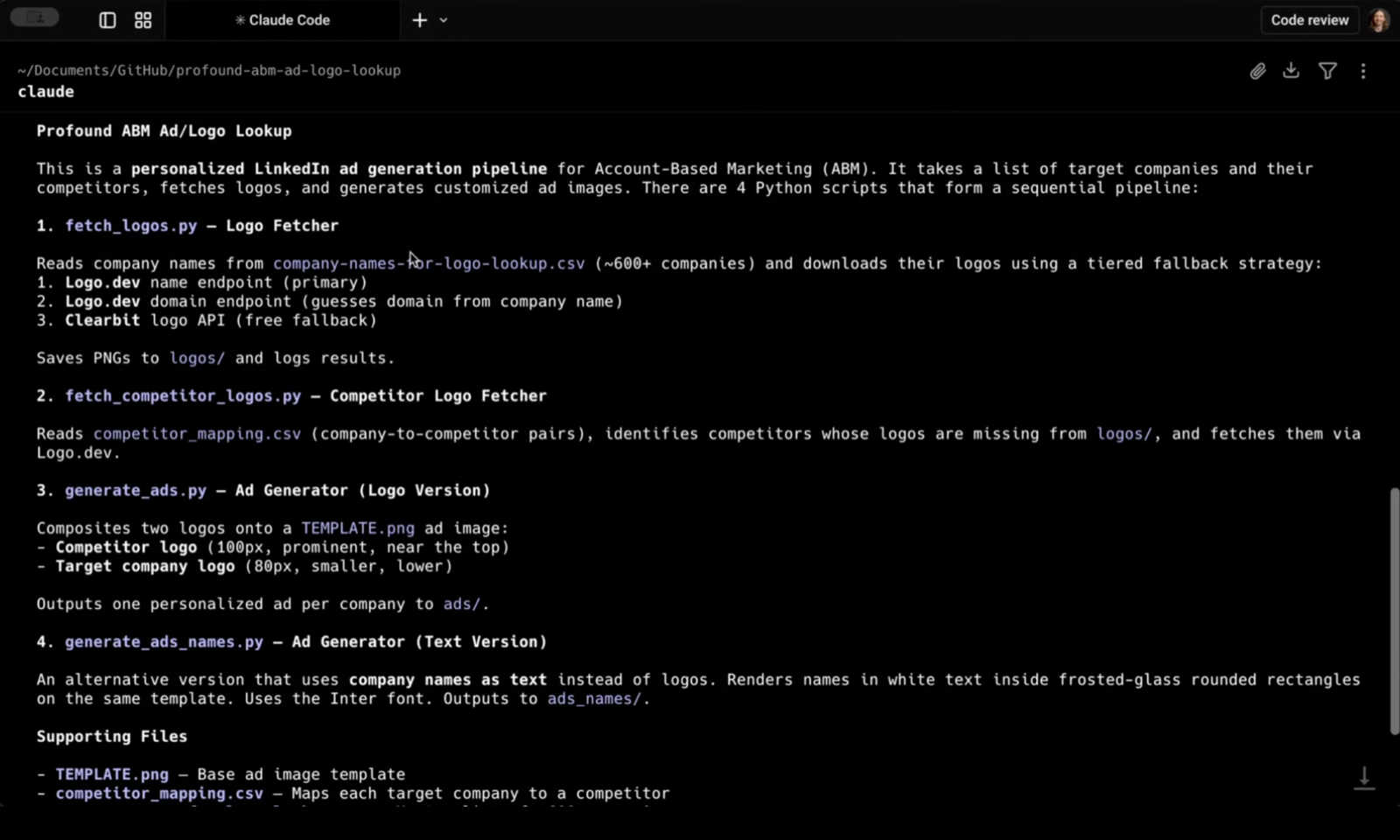
- Orchestrated the entire workflow using Claude Code:After all the data was collected - the template, the logos, the pairing between target account / competitor, Nick used CC to orchestrate the workflow through a Python script and ran it across the entire list.Are there any edge cases that you can think of to this workflow that Claude would need to account for? What additional steps would you add if you were handing this workflow over to a team member?
- Deployed ABM ads as 100+ separate LinkedIn campaigns:LinkedIn is still the king of ABM ads because it allows you to target only employees at a certain company.Note that each ad has to target at least 300 people, so the accounts need to be larger. Nick wasn’t worried about targeting the wrong decision maker at the company, because he knew the ad would get sent around and cut through the noise.Are ABM ads something your growth team should take advantage of as well? How can your existing channels be more personalized?
 <!-- caption: CC-generated summary of the workflow -->
---
What you should takeaway
- **Personalization is (almost) free:**Personalization at scale is now possible across every step of the marketing / 📝GTM funnel. From personalized landing pages to email copy to ABM ads, it is now a matter of taste - your growth team has to continually run experiments to determine which channels are worth it to go the extra mile, and on a micro level, how many dynamic fields there should be
- **Instruct CC to build the workflow in Python, to avoid using Claude tokens every time it runs:**One of Nick’s design principles is not to use CC for every single workflow run. In this case, it was much more cost effective to have Claude build it in Python (or any other coding language). In the future, he can run this workflow 10,000 times without having costs skyrocketNick also always asks the agent to summarize the workflow in a markdown file, which makes it easy to handover to the rest of the org.
- **Take advantage of ABM ads while they are still fresh:**ABM ads are extremely effective. When a prospect sees their own company’s logo on an ad, it “pattern-breaks” their natural firewall against ads and grabs their attention. However, once hyper-personalized ABM ads proliferate, we may see a smaller impact on CTR as people start getting used to them. Act fast!
---
If you want to watch Nick run through this on video, the link is here. Thank you all for reading and please reach out if this spurred any ideas! We’re always looking for more experiments to share with you all.
---